
Guernsey County Court Records After a Jail Arrest
After a person is arrested in Guernsey County and booked into the Guernsey County Jail, the jail roster can show the booking number, booking date, arrest-related charge text, statute information, charging agency, docket number when present, and bail amount when populated. Those entries are important, but they are not the complete court record. The formal case begins when a prosecutor, officer, court, or grand jury filing creates a docket that can be tracked through arraignment, bond review, amendment, plea, dismissal, conviction, sentencing, appeal, or warrant activity.
The distinction matters because a jail booking often appears before the court record is complete. A roster charge may later be declined, corrected, amended, reduced, expanded, or replaced by an indictment. For custody-side details, use jail inmate records; for booking photos, use jail mugshots. Court records after an arrest focus on the charging document, docket events, bond orders, hearings, and final disposition that come from the court system.
How to Find Guernsey County Court Records After an Arrest
Start with the official jail roster only long enough to capture identifiers. The Guernsey County Sheriff's Office 365Labs roster can show a formal charge docket number, statute title, statute description, charging agency abbreviation, and bail amount. Then move to the court that fits the charge. Felony-level cases generally belong with Guernsey County Common Pleas Court records. Many traffic, misdemeanor, and local ordinance matters route through Cambridge Municipal Court or another municipal prosecution path.
- Open the sheriff roster and record the defendant name, booking number, booking date, statute text, charging agency, and any formal charge docket number.
- For felony-level charges or docket references that point to Common Pleas, search the Guernsey County Common Pleas eServices portal.
- For Cambridge Municipal Court matters, enter through the Cambridge Municipal Court CaseLook disclaimer page, accept the disclaimer, and search by party or case information when the fields are available.
- Open the case docket and compare each charge, code section, bond entry, hearing date, warrant entry, and disposition against the roster information.
- If no case appears, allow for filing and posting time. Cambridge Municipal Court warns that CaseLook data may lag at least 24 hours and that verified information should be requested from the court.
- For certified copies, older files, docket images, sealed-access questions, or records not available online, contact the Guernsey County Clerk of Courts or use the clerk request route.
The clerk page identifies Clerk Jennifer Johnson and gives Common Pleas legal division access through the Guernsey County courthouse records system. For Common Pleas General Division records, the research file identifies the clerk phone as 740-432-9230 and the records email as clerkrequests@guernseycounty.org. Cambridge Municipal Court lists the clerk phone as 740-439-5585, email cambcrtclerk@cambridgemunicipalcourt.com, and business hours Monday through Friday, 8:00 a.m. to 4:00 p.m.
The Common Pleas eServices portal is the online route documented for Common Pleas criminal docket access. The screenshot below shows the public-record search landing page captured for the Guernsey County clerk system.
Court Records After Arrest: Complaint, Information, and Indictment
The first public court record after an arrest is usually a charging document or a docket entry tied to one. A complaint can start many misdemeanor cases and can also appear early in felony proceedings. An information is a prosecutor-filed charging document used in some felony cases when the defendant waives indictment or the procedure otherwise permits it. An indictment comes from the grand jury and is common in serious felony prosecution. Guernsey County's prosecutor page states that the county prosecutor presents cases at preliminary hearing, grand jury, and trial, and prosecutes adult felony cases in Common Pleas Court.
| Document | Who Files or Returns It | Common Use | What to Check |
|---|---|---|---|
| Complaint | Law-enforcement officer, prosecutor, or court filing path | Often the first document in misdemeanor or preliminary felony matters | Charge wording, statute, filing date, bond, and next hearing |
| Information | Prosecutor | Felony filing in eligible cases, often after waiver or agreement | Whether it replaces or narrows the original arrest charge |
| Indictment | Grand jury | Felony prosecution, especially more serious charges | Counts, degree levels, added charges, and arraignment after indictment |
Common Pleas, Cambridge Municipal, and Prosecutor Distinctions
Guernsey County does not use a district attorney title. The local felony prosecutor is the Guernsey County Prosecuting Attorney, Lindsey Angler. The office has Adult Felony, Juvenile, Civil, and Appellate divisions, assists with search warrants, presents matters at preliminary hearing and grand jury, and handles felony and juvenile prosecution. Adult felony cases are prosecuted in Guernsey County Common Pleas Court, whose General Division is located at the Guernsey County Courthouse.
The prosecutor's own public description also creates an important boundary: the office generally does not prosecute adults charged with misdemeanor offenses. Cities and villages employ their own misdemeanor prosecutors, while adult misdemeanors in unincorporated Guernsey County are prosecuted by the Cambridge City Law Director's Office. That is why a person arrested into the county jail might later have court records in Common Pleas, Cambridge Municipal Court, a village-related misdemeanor path, or juvenile court depending on the facts.
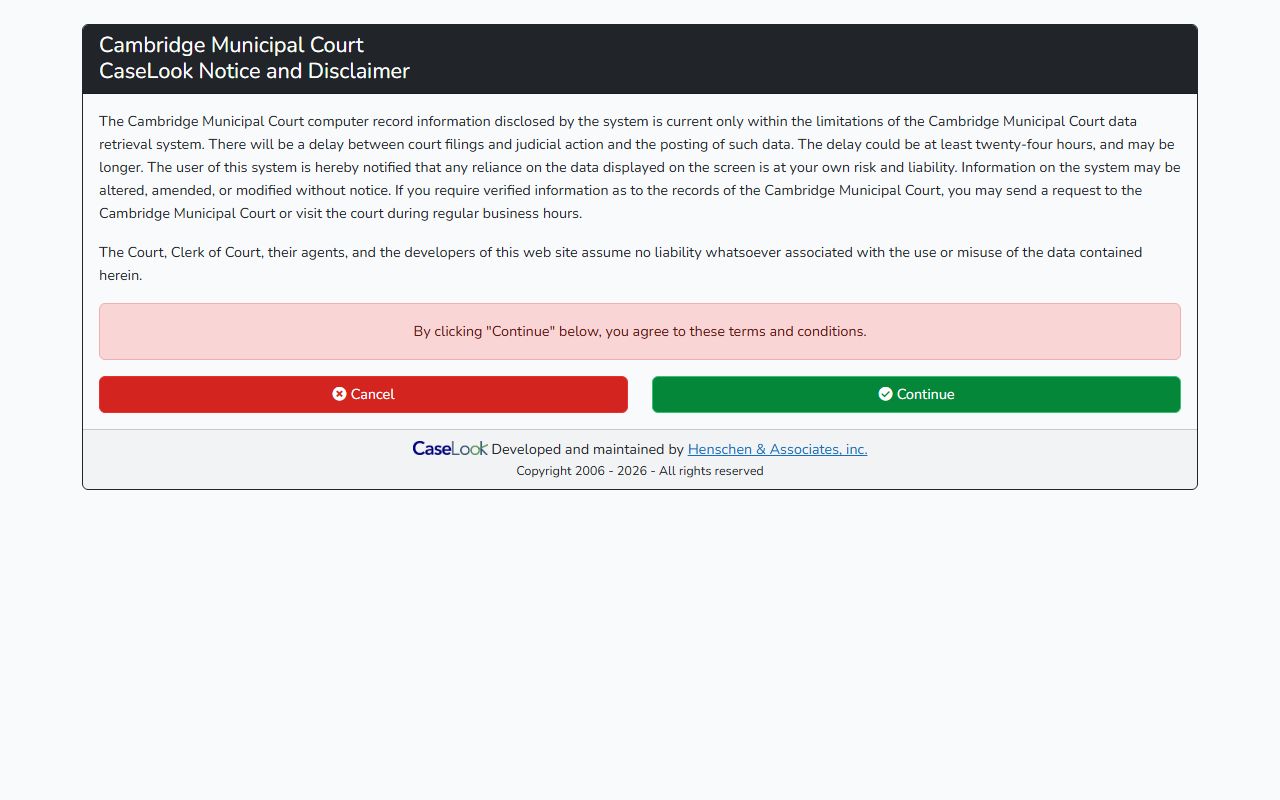
Cambridge Municipal Court CaseLook is useful for municipal, traffic, and misdemeanor records, but its own disclaimer warns that online information may be delayed by at least 24 hours. The screenshot below is from the CaseLook entry page, where users must accept the disclaimer before searching.
Charge Status in Court Records After a Jail Arrest
Charges do not stay fixed just because a jail roster listed them at booking. Court records after an arrest can show that a charge was filed as written, amended to different language, reduced to a lower degree, dismissed, bound over, indicted, or resolved by plea or trial. A roster entry is a custody record; the docket is where the active legal status is tracked.
| Status | What It Means | Why It Matters |
|---|---|---|
| Pending | The charge is active and has not reached final disposition. | Hearings, bond terms, warrants, or negotiations may still change the case. |
| Amended or Reduced | The filed charge changed from the original wording, degree, count, or statute. | The final court record may no longer match the jail roster's booking charge. |
| Dismissed | The court ended that charge without a conviction on that count. | A dismissal is not the same as a conviction, but the public docket may still show the filing unless sealed or expunged. |
| Nolle Prosequi | The prosecutor declined to continue prosecuting that charge, with court handling as required. | The docket should be checked for whether the dismissal was with or without future filing consequences. |
| Convicted or Guilty Plea | The defendant was found guilty or entered a plea accepted by the court. | Sentencing, probation, fines, jail credit, or transfer to ODRC may follow. |
Bond Records After a Guernsey County Arrest
The Guernsey County roster can display bail amounts at the charge level when the data is present, and the underlying portal includes a bond popup and appearance-form functions for some bookings. Formal bond control still belongs to the court. A first appearance, arraignment, warrant, probation violation, detainer, or later court order may change whether payment is available or whether release is blocked.
Because Guernsey County-specific bond-posting instructions were not located on the sheriff pages reviewed, the safest route is to check the roster first, confirm custody and bond status with the jail at 740-439-4455, then confirm the case-specific bond order with the court. Cambridge Municipal Court publishes bond and waiver cost links and accepts certain payments, but not every bond is payable online. For Common Pleas felony cases, use the clerk record and court instructions for the specific docket.
| Bond Type | How It Works | Record Clue |
|---|---|---|
| Cash Bond | Money is paid directly under the court's rules and may be subject to fees, costs, or refund rules after the case. | A docket or roster may show a dollar amount for the charge. |
| Surety Bond | A commercial bail agent may post if the court accepts surety for that case. | The bond order should state whether surety is permitted. |
| Recognizance or Personal Bond | The defendant is released on a promise to appear and comply with conditions, without paying the full amount up front. | The docket may show OR, PR, personal bond, or conditional release language. |
| No-Bond Hold | Release is blocked by court order, warrant, probation/parole hold, detainer, or another jurisdiction. | The roster or docket may show hold, no bond, capias, detainer, or probation violation language. |
Warrants That Become Court Records After an Arrest
Guernsey County did not have a complete official searchable active-warrant database in the researched sheriff materials. The sheriff does publish a most-wanted page, wanted-person tip form, anonymous tip email at tips@guernseysheriff.com, anonymous tip phone at 740-439-6300, and investigations contact path through 740-439-4455 option 4. Those public notices are not the same as a full legal warrant index.
A warrant can still be visible through court records after a jail arrest. Common docket language may include arrest warrant, bench warrant, capias, failure to appear, probation violation, bond forfeiture, or holder. Search warrants are different; they authorize a search of property and are not public wanted-person records. Anyone trying to verify or resolve a possible warrant should contact the issuing court, counsel, or the sheriff's office rather than relying only on a website.
Charges vs. Convictions in Arrest Court Records
A charge is an accusation filed into a case. A conviction is the result of a guilty plea, no-contest plea accepted with finding, trial verdict, or other final court finding that creates guilt on a count. Ohio court records can show both, but they should not be treated as the same thing. The jail roster itself includes a presumption-of-innocence notice, and the court record should be read with the current disposition in mind.
| Record Point | Charge | Conviction |
|---|---|---|
| Stage | Accusation after arrest or later filing | Final finding by plea, verdict, or accepted disposition |
| Proof Level | Based on probable cause or filed allegations | Requires proof beyond a reasonable doubt or an accepted plea |
| Where It Appears | Roster, complaint, indictment, information, docket | Docket disposition, sentencing entry, judgment entry |
| Practical Effect | May affect bond and court appearances | May affect sentence, probation, fines, jail credit, or prison transfer |
Sealed vs. Expunged Court Records After an Arrest
Ohio public access rules allow many court records to be inspected, but that does not mean every arrest, dismissal, juvenile matter, or identifying detail remains public forever. The Guernsey County Clerk public-records materials cite ORC 149.43 for public records and note that sealed records, expunged records, protected identifiers, medical or mental-health material, financial identifiers, juvenile-protected content, and other exempt information may be restricted or redacted.
| Record Point | Sealed | Expunged |
|---|---|---|
| Public Visibility | Hidden from ordinary public access after a court order. | Removed or treated under Ohio's expungement framework after an eligible court order. |
| Government Access | Some agencies may retain limited legal access depending on the record and statute. | Access is more restricted and depends on the type of record and order. |
| How It Starts | Usually by filing in the court that handled the case. | Usually by filing in the court that handled the case, if eligible. |
| Effect on Roster Material | Use the court order and originating agency route to request correction or restricted public display. | Use the court order and originating agency route to request correction or restricted public display. |
Public Access and Clerk Request Route
Ohio Revised Code 149.43 is the main public-records statute. It creates access to nonexempt records kept by public offices, while allowing redaction or withholding where another law protects the material. The clerk's public-records instructions also cite ORC 149.45 for protected personal identifiers such as Social Security numbers, driver's license numbers, tax identification numbers, account information, and similar data.
For court records after a Guernsey County arrest that are not available online, use the clerk's public-record request process rather than the sheriff's incident-report process. Provide the case number if known, defendant name, approximate filing date, court division, and the specific document requested, such as complaint, indictment, bond order, sentencing entry, docket sheet, or certified copy. Ohio agencies may ask for enough detail to identify and process a request, but the clerk materials state a requester is not generally required to provide identity or a reason unless needed for delivery or processing.
FCRA notice: This resource is not a consumer reporting agency and cannot be used for employment, housing, credit, insurance, or other FCRA-regulated decisions.
Restricted Court Records After an Arrest in Guernsey County
Some court records after an arrest may be unavailable online or unavailable to the public. Common limits include juvenile cases, sealed or expunged records, protected victim information, medical and mental-health material, financial identifiers, social security numbers, driver's license numbers, ongoing investigation material, and documents restricted by a specific court order. If an online docket shows a case exists but not the image or filing, the clerk is the correct route for access questions and certified-record needs.
Public Record Search
Sponsored Results